

Rethinking back pain research
Low back pain is one of the most widespread and disabling health conditions worldwide. According to the World Health Organization (WHO), 619 million people globally were affected by low back pain in 2020, making it the condition for which the greatest number of people may benefit from rehabilitation. The global burden is expected to rise sharply, with up to 843 million people projected to be living with low back pain by 2050, driven largely by population growth and ageing. Despite its prevalence, in around 90% of cases no specific structural cause of back pain can be identified, underscoring how little is still understood about the biological mechanisms that turn everyday spinal loading into chronic pain.
A bioreactor that moves in six directions
The intervertebral disc is a complex, living organ. Its cells respond not only to biochemical signals but also to how the spine moves: Compression, bending, rotation, and shear. Traditional cell cultures cannot reproduce this environment. It has therefore been difficult to pinpoint which mechanical conditions trigger degeneration—and which might support maintenance and eventually recovery of the tissue.To overcome these limitations, Sibylle Grad, Focus Area Leader Disc and Cartilage Biology at the AO Research Institute Davos, and her group, have developed unique
whole-organ disc bioreactors that apply load and motion in six degrees of freedom, closely mimicking daily spinal movement.
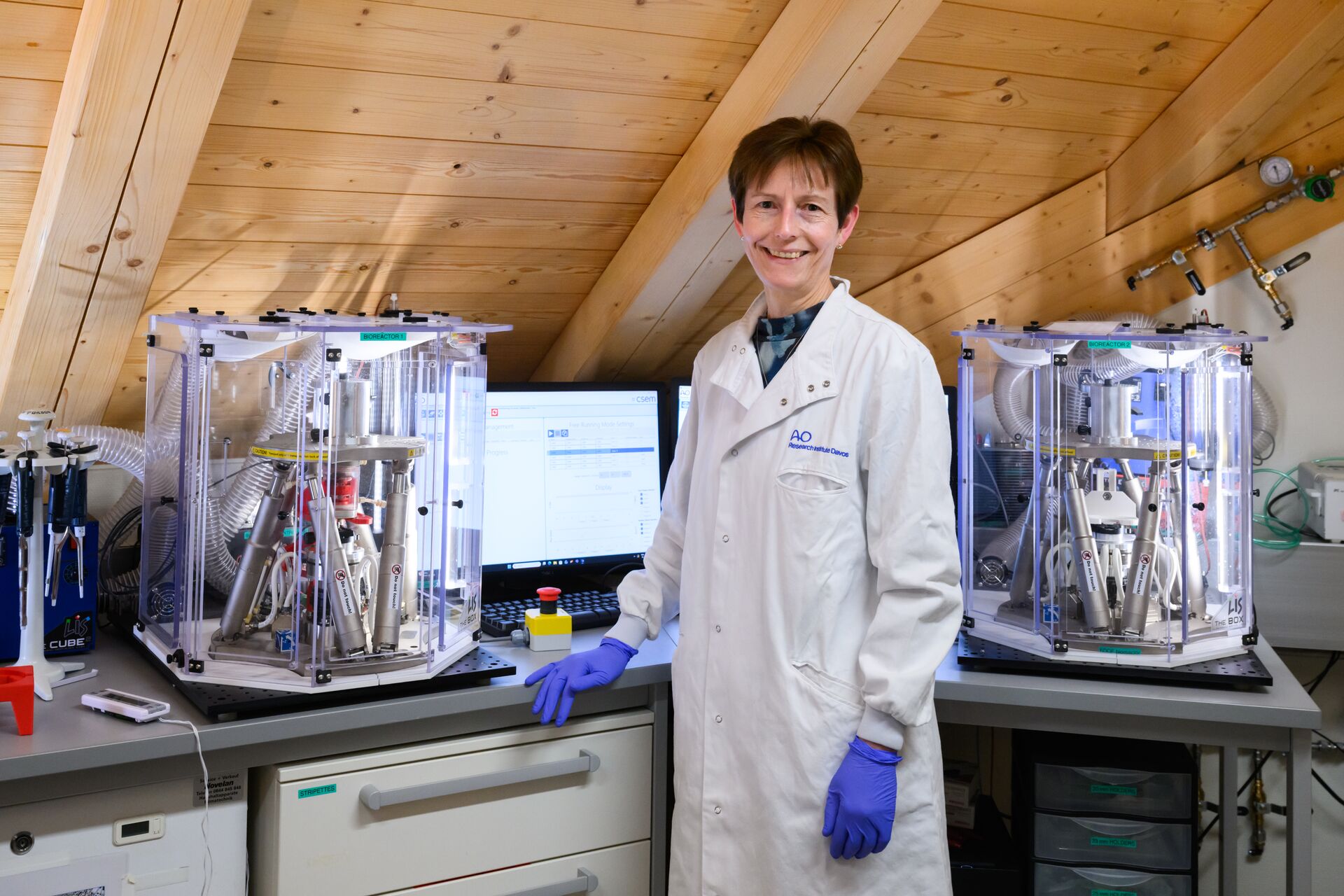
Entire intervertebral discs—obtained locally from bovine tails shortly after slaughter—are cultured for several weeks under carefully controlled nutrition, temperature, humidity, and pH while being mechanically stimulated. During experiments the discs remain biologically viable, preserving cellular activity, tissue structure and mechanical properties.
This approach allows the ARI’s researchers to observe how disc cells and tissues respond over time to different loading scenarios, from physiological motion to potentially harmful patterns.
From mechanical stress to pain signals
One of the team’s key research questions is how mechanical overload may translate into pain. In a recent study that received the ISSLS Prize 2026 for Basic Science, discs exposed to dynamic multiaxial loading showed region‑specific inflammatory and catabolic responses, particularly in the outer annulus fibrosus. When nerve cells were exposed to molecules released by these loaded discs, they exhibited signs of neural sensitization.
In simple terms, this means that when the disc is exposed to too much or the “wrong” kind of movement—such as repeated bending, twisting, or compression—it begins to release chemical signals. These signals can “irritate” nearby nerve cells, making them more sensitive and more likely to send pain signals to the brain, even before visible damage occurs.
Such findings help explain why certain movement patterns may provoke pain even before structural damage is visible on imaging.
In the longer term, this research could help clinicians better identify which types of mechanical stress are harmful, refine rehabilitation strategies, and guide the development of targeted therapies that intervene earlier in the disease process. By linking how the spine moves to how pain develops, these models bring us closer to treatments that address the underlying causes of back pain—not just its symptoms.
Why this matters
-
Scale of the problem:
Low back pain is the leading cause of disability in more than 160 countries, and the condition with the highest global need for rehabilitation, according to the WHO.
-
Diagnostic uncertainty:
With around 90% of low back pain classified as non‑specific, clinicians often lack clear biological targets for intervention. This contributes to variability in treatment outcomes and highlights the need for research beyond imaging.
-
Understanding loading patterns:
Everyday spinal movements—compression, bending, rotation, and shear—play a decisive role in disc health and degeneration. Understanding the effects of different loading is essential for improving prevention strategies, rehabilitation protocols, and post‑intervention guidance.
-
Translation to practice:
For clinicians, this research helps bridge the gap between biomechanics, biology, and patient‑reported pain—informing future regenerative therapies, load‑adapted rehabilitation, and more targeted clinical decision‑making.